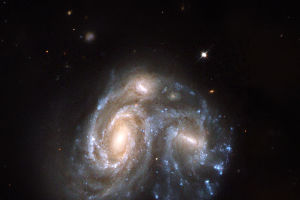
When the Hubble Space Telescope began observing the universe from above Earth’s atmosphere, it gave astronomers an exceptionally clear view of distant objects in space.
Its observations have transformed our understanding of galaxies, stars, planetary systems, black holes, and the history of the universe.
Hubble’s importance extends beyond its remarkable images. Its observations have provided precise measurements, revealed structures that were difficult to study from the ground, and opened new ways to investigate how the universe has changed over billions of years.
Measuring the Universe More Precisely
One of Hubble’s major contributions has been improving measurements of the universe’s expansion rate. Astronomers use objects such as Cepheid variable stars and Type Ia supernovae as distance indicators, allowing them to determine how far away galaxies are and compare those distances with their motion.
Hubble’s observations helped establish the expansion rate with greater precision and contributed to the modern estimate that the universe is approximately 13.8 billion years old. Measurements of the expansion rate remain an active area of research because different methods can produce somewhat different results.
Seeing Galaxies Across Time
Because light takes time to travel, observing distant galaxies allows astronomers to see them as they appeared in the past. Hubble’s deep-field observations revealed thousands of galaxies within remarkably small regions of sky, showing that seemingly empty areas can contain vast numbers of distant objects.
These observations have helped scientists study how galaxies develop over cosmic time. By comparing galaxies at different distances, astronomers can investigate changes in their structures, star formation, interactions, and growth.
Revealing Supermassive Black Holes
Hubble has provided important evidence for supermassive black holes at the centers of many galaxies. Its high-resolution observations allow astronomers to study the movement of stars and gas near galactic centers, revealing the gravitational influence of extremely massive and compact objects.
These observations have strengthened the evidence that supermassive black holes are widespread in galaxies and have helped scientists investigate the relationship between central black holes and the galaxies around them.
Observing Planet Formation
Hubble also produced some of the first direct images of protoplanetary disks around young stars. These disks contain gas and dust that can provide the material from which planets develop.
Observing these structures gave astronomers direct visual evidence of environments associated with planet formation. Hubble has also studied exoplanet atmospheres by observing changes in starlight as it passes through them, helping researchers investigate the properties and composition of worlds beyond our solar system.
Evidence for an Accelerating Universe
Hubble observations of distant Type Ia supernovae contributed to evidence that the expansion of the universe is accelerating rather than simply slowing under the influence of gravity.
This discovery led to the concept of dark energy, the term used for the unknown component associated with the accelerated expansion of the universe. Hubble provided key observations for this discovery, alongside observations from other astronomical facilities. The nature of dark energy remains an open question in cosmology.
A Lasting Legacy
Hubble changed astronomy by making distant and faint cosmic objects far easier to study in detail. Its observations have improved measurements of cosmic expansion, revealed galaxies across vast stretches of cosmic history, strengthened evidence for supermassive black holes, captured planet-forming disks, and contributed to our understanding of accelerated cosmic expansion.
Its lasting legacy is a deeper and more detailed picture of the universe. By observing distant light and structures with exceptional clarity, Hubble has helped astronomers understand how galaxies evolve, how planetary systems develop, and how the cosmos has changed across billions of years.